I'll let you guys figure out what the P is, (think giant pool at a rec center...), but thought the momentous occasion of my re-acquaintance with the world of P was worth recording, being another step toward the best job on the planet!
So what do you all think of my entry into the water? I think it was the best I've ever done! ;-) Heck, why don't you guys out there join me in (re)discovering the art of swimming!!
PS. I haven't forgotten about the most deadly little critters down at the reef. I'm just waiting for them to get back to me with their bios - you know how life in the tropics is in a bit slower current of time...these guys just chowin' on one last plate of plankton before getting down to business!
Showing posts with label most venemous creatures. Show all posts
Showing posts with label most venemous creatures. Show all posts
Sunday, February 15, 2009


Monday, February 9, 2009
Sea Snake Swim.

See Johnny stare. See snake check Johnny out. See Johnny wet his suit. See snake swim after minnows instead. See Johnny leave snake alone.
Olive sea snake
flickr: by Wibble_Roisin
So goes a theoretical kindergarten book on sea snakes in the ocean and the great respect we should have for them. Critter #2 on the most poisonous list are sea snakes. Keep in mind this list is in no particular order - all these critters deserve a place in it without discrimination.
Around the Great Barrier Reef, there are 14 species of sea snake, more or less. One of the most common is the Olive sea snake, which can grow up to 2 meters in length. It bears live young (as do all but 5 species), and can stay underwater for 30 minutes to 2 hours, depending on how active it is. Hey, you could hold your breath that long, too if you had a lung that grew all the way to your shins.
Even cooler, it seems that sea snakes can breathe through their skin, too, which gives them the distinct advantage of being able to get to the surface if they forget to look at their dive watches to see how long they've been down. (Just kidding, they don't really have dive watches...) They can actually meet up to 20% of their oxygen needs through their skin.
Contrary to popular belief, not all sea snakes are venomous. The Turtlehead sea snake, for instance, just eats caviar (a very high society snake). Being against violence, wearing furs, and all that stuff, it doesn't really need any venom.
But, the Olive sea snake does have venom. And it is very curious (just ask Johnny). Fortunately, as a general rule, sea snakes aren't mean-spirited, and won't try to bite you just because you're lookin' at 'em. And they typically have little fangs, and like to conserve their venom. Which is good because like the venom in a lot of sea creatures, the venom of sea snakes is very deadly. It takes up to 100 times as much venom to cause death in humans from a land snake bite as it does from a sea snake bite. Bummer for eels, which are oh, so much smaller than humans... =(
The usual follows upon being bitten. Voluntary muscle paralysis (and disintegration), brown or black pee (those were DEFINITELY the wrong vitamins), and eventually respiratory failure, cardiac arrest and death. The good news is that can take several hours, giving you enough time to get to a hospital and get some HELP!
Check out these VIDEOS on youtube for some more sea snake action, and as always, keep your fingers to yourself... ;-)
Sunday, February 8, 2009
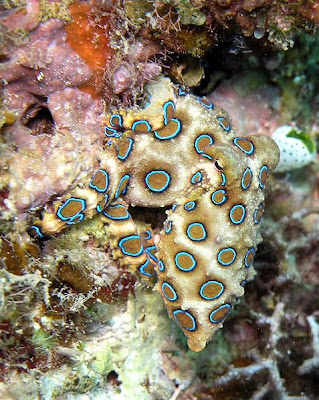
Electric Blue Golf Balls of Death
Sounds dramatic because it is. Yeah, while researching the Great Barrier Reef, I stumbled on some nasty little critters. Well, they're only nasty if you're nasty to 'em first, but I've decided to do a TOP TEN list of deadliest critters at the GBR.
Critter #1 - Normally, it trys to blend in to its surroundings and is brownish or greenish, with dull blue rings. Yes it's also the size of a golf ball, kind of like those cute little gremlins back in the '80's. Until you water them. Then, BAM! Three minutes from death. The first top ten selection is the Blue Ringed Octopus. There are actually three confirmed variations of the species.
While it's tiny, it has a beak that can cut through a wet suit, and venom that it mixes with its saliva, so when it bites you, in goes the venom. 3 minutes later, you're in cardiac arrest and respiratory failure. AND, there's no anti-venin for it.
The nice thing is it's very non-aggressive and only bites when it's threatened (i.e. someone tries to pick it up). Fortunately, it's rings glow electric blue like a neon sign when it's feeling insecure. Unfortunately, that's usually a split second before it strikes.
The great news, of course, is that if you get CPR and life-support, you'll be ok when the venom works its way out of your body several hours later. Rule of thumb: Don't pick up little electric blue golf balls of death...
If you want more info, like the ingredients of the toxin (fascinating for all you medical types) check out (you guessed it) http://en.wikipedia.org/wiki/Blue-ringed_octopus.
At any rate, tune in tomorrow (later today?) for the next critter in the list, and possibly some footage that I shot today. Have to say it's been fun being the "man on the street" interviewer! AND, I'll be sharing some guidelines I'm picking up in the process of filming...
Critter #1 - Normally, it trys to blend in to its surroundings and is brownish or greenish, with dull blue rings. Yes it's also the size of a golf ball, kind of like those cute little gremlins back in the '80's. Until you water them. Then, BAM! Three minutes from death. The first top ten selection is the Blue Ringed Octopus. There are actually three confirmed variations of the species.
While it's tiny, it has a beak that can cut through a wet suit, and venom that it mixes with its saliva, so when it bites you, in goes the venom. 3 minutes later, you're in cardiac arrest and respiratory failure. AND, there's no anti-venin for it.
The nice thing is it's very non-aggressive and only bites when it's threatened (i.e. someone tries to pick it up). Fortunately, it's rings glow electric blue like a neon sign when it's feeling insecure. Unfortunately, that's usually a split second before it strikes.
The great news, of course, is that if you get CPR and life-support, you'll be ok when the venom works its way out of your body several hours later. Rule of thumb: Don't pick up little electric blue golf balls of death...
If you want more info, like the ingredients of the toxin (fascinating for all you medical types) check out (you guessed it) http://en.wikipedia.org/wiki/Blue-ringed_octopus.

At any rate, tune in tomorrow (later today?) for the next critter in the list, and possibly some footage that I shot today. Have to say it's been fun being the "man on the street" interviewer! AND, I'll be sharing some guidelines I'm picking up in the process of filming...
Subscribe to:
Posts (Atom)


 Posts
Posts

